
On July 1, New Hampshire’s state building code moved to the 2024 editions of six model codes. If you are buying a newly built house in New Hampshire this fall, there is a good chance it was designed and permitted under the older rule book, and that two houses finishing on the same street right now are being held to different editions. That is legal, it is normal, and you cannot tell which is which by looking at the siding.
What actually changed on July 1
The Building Code Review Board’s own summary of the New Hampshire Building Code including amendments effective July 1, 2026 says it plainly: the package was ratified by the General Court through HB1159-2026, signed by the governor on May 8, 2026, and took effect July 1. Six of the adopted model codes moved to their 2024 editions, including the International Residential Code, which is the one that governs detached one and two family homes. Two did not move. The energy code stays at the 2018 International Energy Conservation Code, and electrical work stays on the 2023 National Electrical Code.
For a buyer, the headline is not the edition number. It is the date attached to the paperwork.
Why two codes are in play until the end of December
Under RSA 155-A:2, the state building code in effect when the building permit application is received by the governing authority stays in effect for the whole duration of the work covered by that permit. A house permitted in March 2026 is a 2021 code house even if it closes in November. The permit date decides, not your closing date.
On top of that, the same statute opens a six month concurrency period after a new code takes effect. During it, an applicant may show compliance using either the code in effect just before the change or the new one, in the statute’s words, “but not a combination of the 2 codes.” Six months from July 1 runs out at the end of December. So through the rest of this year, a builder pulling a fresh permit in New Hampshire gets to choose.
Here is the useful part, and it costs you nothing. Call the code office in the town where the house sits and ask for the permit file. Ask which code edition the permit was issued under, which inspections were signed off and on what dates, and whether a certificate of occupancy has been issued. That is a public record. You do not need to hire anyone to get it, and you should have it in hand before you are asked to waive anything.
Maine runs on a different clock
Maine is not on the same cycle and it does not work the same way. The Maine Uniform Building and Energy Code applies to buildings constructed or renovated statewide, but enforcement is population based. It must be adopted and enforced in municipalities with 4,000 residents or more, while smaller towns may choose to. The current amended adoption has been in force since April 7, 2025 and sits on the 2021 I-codes, along with ASHRAE 62.2 for residential ventilation and ASTM E-1465, the standard practice for radon control options in new low-rise homes.
The practical translation for a buyer looking at new construction in a small Maine town: there may be no code officer, no framing inspection and no certificate of occupancy, because the town never took it on. The code still applies to the building. Nobody was necessarily there to check. Ask the town office directly rather than assuming.
What a municipal inspection is not
A code inspection is a minimum compliance check at a few defined stages of construction. It is not a condition report, it is not a punch list, and it is not built around your interests as the buyer. We inspect new construction in Maine and New Hampshire, and the same findings come back: the bath fan ducted into the attic or the soffit instead of through to the outside, crawlspace vapor barrier laid loose and unlapped around the piers, a dryer duct crushed flat behind the machine, missing kick-out flashing where a roof edge meets a wall, condensate line dumping into the crawlspace, final grade sloping back toward the foundation after the landscaping crew finished, neutrals and grounds landed on the same bar in a subpanel.
None of that is exotic and almost none of it is the builder being careless on purpose. It is what a fast schedule and a dozen trades produce. It is also all fixable while the builder still has a reason to fix it, which is before you close, not after.
Radon is the number no code can give you
Maine’s code points to a radon control design standard for new homes. A design path is not a result. The only way to know what the finished house does is to measure it. The EPA recommends fixing a home at 4 pCi/L or higher, and because there is no known safe level, recommends considering a fix between 2 and 4 pCi/L. The average indoor level in American homes is about 1.3 pCi/L. A new house can still test above the action level, which is why we treat new construction the same as a hundred year old farmhouse. We place the sensor, leave it for the test period, recover it, and report the number.
Before you close
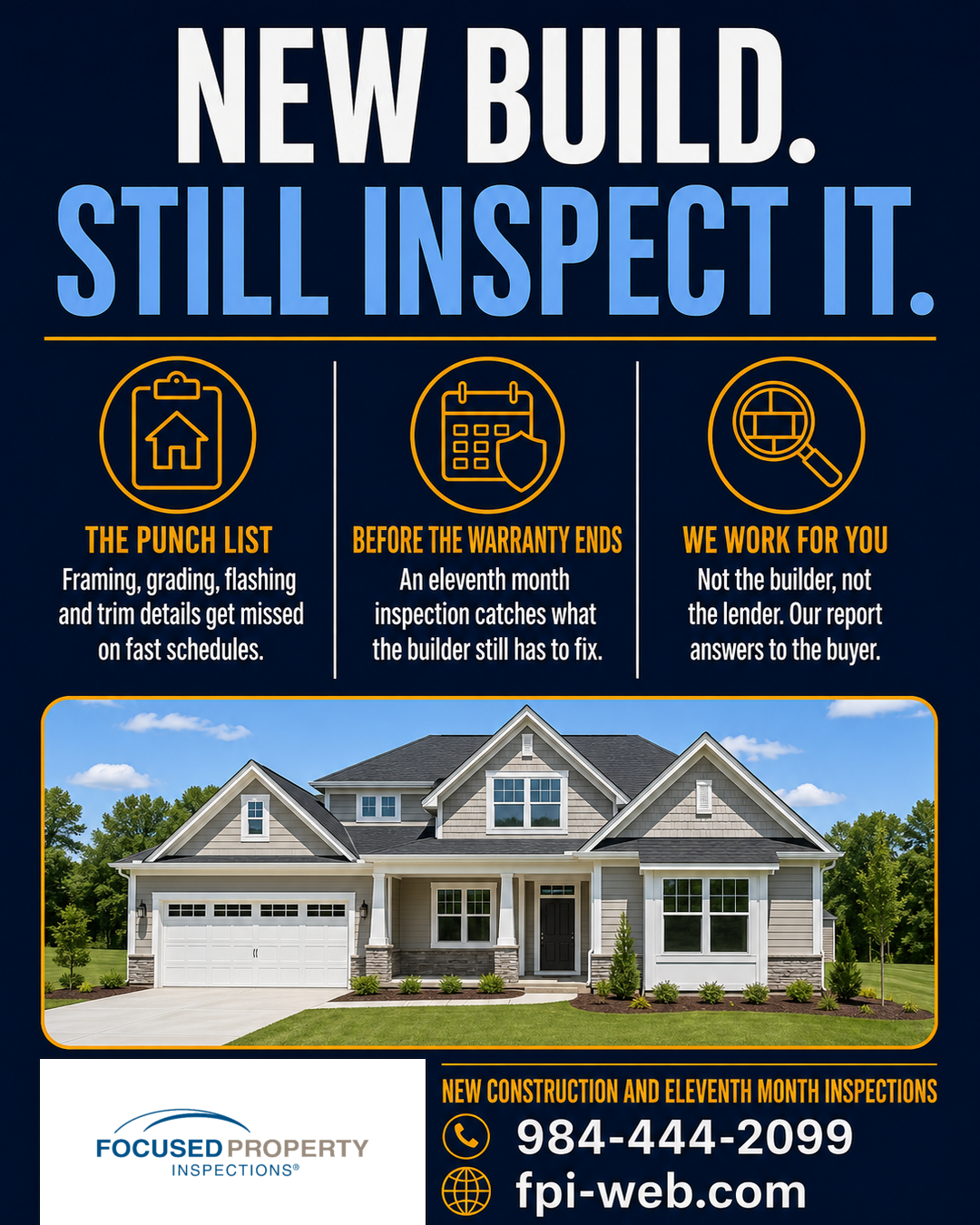
Ask the builder which code edition the permit was filed under. Pull the permit file yourself. Ask for the certificate of occupancy and the appliance manuals. Then have the house inspected anyway, by someone who works for you.
Focused Property Inspections covers New Hampshire and Maine, including Greater Portland. We handle the home inspection and radon testing in the same visit. Call (207) 839-6595.