
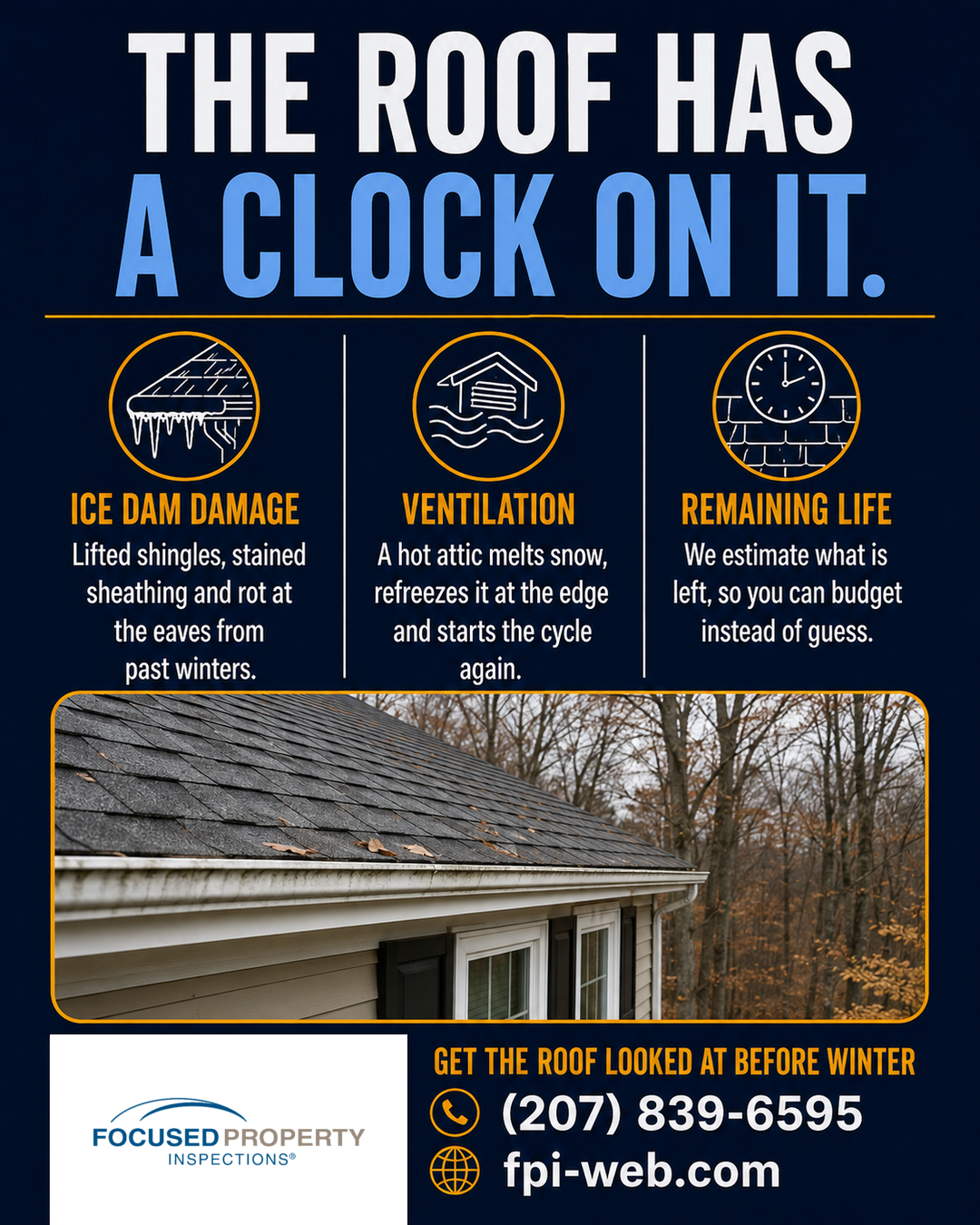
Maine’s closed sales fell 4.15 percent in September against a year ago, while the median price rose 2.6 percent. The Maine Association of REALTORS counted 1,526 existing single-family sales, down from 1,592, with a statewide median of $415,000 (Maine Association of REALTORS housing report, released October 13, 2026). The association’s president pointed to higher mortgage rates and more homes on the market, which gives buyers more choices and more time. If you close this month or next, the first thing that house will do under your ownership is get through a winter. The attic is where that winter shows up first.
What an ice dam actually is
An ice dam is a heat problem, not a gutter problem. Heat leaks from the living space into the attic, warms the roof deck, and melts the snow sitting on it. The meltwater runs down to the eave, which is unheated and stays at outdoor temperature, and refreezes there. The ice builds into a ridge, and the next round of meltwater backs up under the shingles and into the house.
Two sources say the same thing in different words. The Building America Solution Center, run by Pacific Northwest National Laboratory with U.S. Department of Energy funding, calls air sealing the ceiling plane the most important step and recommends R-60 or more of attic floor insulation in climate zone 5 and colder (Building America Solution Center, ice dam prevention). A University of Massachusetts Amherst building technology article puts the northern minimum at R-38 and lists the leaks to chase: wire and plumbing penetrations, ceiling light fixtures, attic hatches, chimneys, bath fans, and the joint where interior partitions meet the ceiling (UMass Amherst Building and Construction Technology, preventing ice dams). The UMass piece is marked archived, so treat its R-38 as a floor and the R-60 as the current target.
What we see when we open the hatch
Most buyers have never been in the attic of the house they are about to own. We go in on every inspection where it is safe to do so, and the same handful of things come up again and again in Maine and New Hampshire houses.
Insulation that was installed deep in the middle of the attic and thins to almost nothing at the eaves, because the rafters come down onto the exterior wall and there is no room. That is the exact spot where the roof edge needs the most help. Soffit vents buried under blown insulation, so the air channel the roof depends on is closed off. A bath fan ducted into the attic space instead of outside, which dumps warm, wet air right where you do not want it. Dark staining on the underside of the roof sheathing around nail tips, a sign that moisture has been condensing there for more than one season.
None of these is a reason to walk away. All are reasons to know before closing, so you can ask for a credit or budget the work.
What an inspection can and cannot tell you
An inspection in October cannot tell you whether a roof has ice-dammed before. There is no snow and no ice. What it can do is read the evidence the last winter left behind and judge whether the attic is set up to fail. Look at the ceiling below the eaves for old water stains. Look at the exterior edge of the roof for stained or lifted shingles and rotted fascia. Look at the insulation depth against the numbers above.
Ask the seller in writing. Has the roof leaked at the eaves in winter? Has anyone added insulation or air sealed the attic, and when? Are there heat cables on the roof? Heat cables are a red flag, not a fix. They usually mean the house has already had the problem, and the UMass article lists heat tape among the measures it does not recommend.
We are also honest about the limit. We inspect what is visible and accessible. We do not pull insulation back from every joist bay, and we do not guarantee that a roof will stay dry in a given winter. A tight attic can still ice up under the wrong conditions.
What you can do yourself, and when you do not need anyone
If the attic hatch is a plain piece of drywall or plywood with no weatherstripping and no insulation on top, you can fix that this weekend for the cost of foam board and a roll of weatherstrip. If you can see soffit vents blocked by loose insulation, you can pull it back and install baffles. Both are small jobs that cost little and help right away.
Larger work is a different matter. Air sealing a whole ceiling plane, adding insulation up to R-60, and correcting eave details are jobs for a weatherization contractor, and the cost depends on the house. Get more than one quote. For a house you are still buying, find out what the attic needs while you still have negotiating room.
A fall-closing checklist
Our inspectors work across Portland, Windham and the Sebago Lakes region, Portsmouth, and Dover. See our services, or the Maine and New Hampshire market pages.
To schedule a home inspection in Maine or New Hampshire, call Focused Property Inspections at (207) 839-6595. Darryl, who owns FPI and is a Master Home Inspector with thirty years in Maine, would tell you the same: look up before the snow comes, not after.