
The nor’easter that stalled off southern New England this weekend gave Maine its heaviest rain in months, and Maine is a state that is entirely in drought. WGME’s storm summary put Scarborough near 4 inches, South Portland at 3.28 inches, and Portland at a daily record of 1.88 inches on September 27, with rain still in the forecast into Tuesday. If you are under contract on a Maine or New Hampshire house this week, that storm did you a favor. Most inspections happen on dry days. This one you can read with the ground wet.
Why hard ground makes this rain a real test
Before the storm, Press Herald meteorologist Keith Carson explained on September 24 that Maine’s coast needs 11.29 inches of rain in a single month to erase its deficit. He also warned that concentrated rain on drought-hardened soil tends to pond and run off instead of soaking in.
That runoff has to go somewhere, and on a house it goes to the foundation. The drought.gov Maine page showed 100 percent of the state in moderate drought or worse on its September 22 map, about 1.3 million residents, and August precipitation of 2.85 inches, 0.66 below normal. That map predates the storm, so treat it as the backdrop, not the current score.
Here is my read, and it is an inference, not a measurement. Soil that has dried for months shrinks and can open gaps beside a foundation. The first hard rain finds those gaps, along with any grading, gutter or downspout problem that was already there. A house that stays dry through this weekend has passed something.
What we do on a wet day
We walk the outside before we go into the basement. In the field, that walk tells you most of what the basement is going to say.
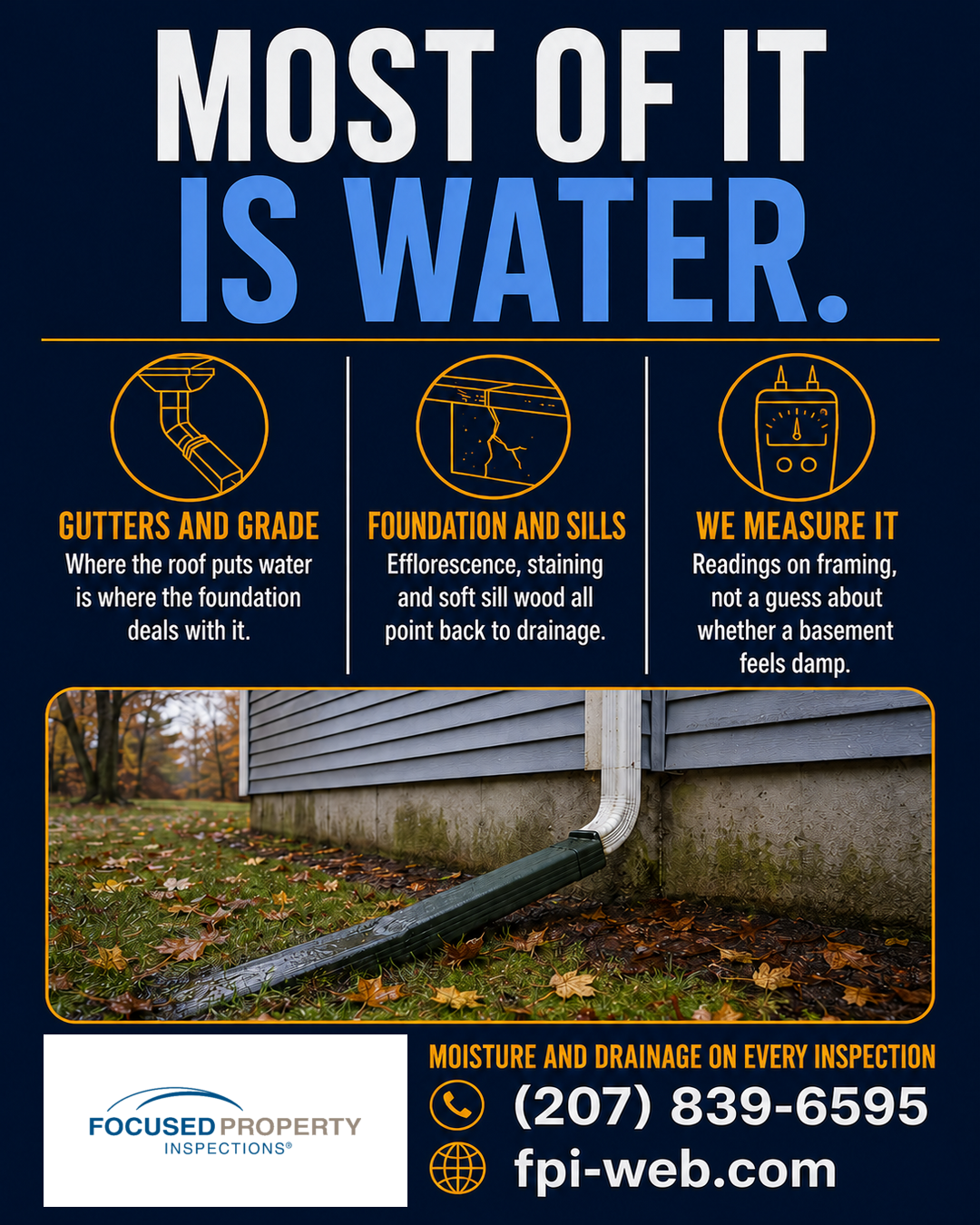
With the gutters running, we watch where each downspout lands. Water dumped at the foundation corner, a gutter overflowing at an inside corner, or a splash line of dirt on the lower siding all point to the same fix. The University of Minnesota Extension gives the target we measure against in its guide to basement moisture: soil that slopes away from the foundation at least 1 inch per foot for at least 6 feet, and downspout extensions that discharge at least 4 feet from the wall.
Then we go down with a flashlight and look at the places water actually shows up: where the slab meets the wall, the bottom of the stairs, the sill plate, and behind stored boxes that hide the wall. We check whether there is a sump pit, whether it has water in it, and where the discharge pipe ends. We also smell the space, because a clean-looking basement can still smell wet.
White, chalky deposits on masonry, called efflorescence, are the mineral residue left when water has moved through the wall. On a dry day that residue is the only record of past water, so we photograph it and ask the seller about it.
What a dry basement does and does not tell you
A dry basement after 3 or 4 inches of rain is good news. It is not the whole answer.
Groundwater is low this year, so the water table has not been tested the way it is in a wet April, when snowmelt and spring rain push up against the foundation. Carson’s column also noted that a strong El Nino usually brings average or below-average winter precipitation to Maine. If that holds, this may be one of the few chances to see the house under rain before spring, and even then it is one storm. One dry walk-through in a drought year is weaker evidence than the same walk-through in a wet season.
Ask the seller directly about past water, sump pump history, and any repairs at the foundation. Ask for receipts. A house that has been fixed and stayed dry is a better story than a house that has never been asked.
If you find water
Do not panic, and do not assume the deal is dead. Many wet basements trace to a gutter that has been clogged for a year or a downspout that drops at the foundation. Those are cheap to fix, and you can check both yourself: watch the downspouts during rain, then measure the slope. You do not need to hire anyone for that step.
Where the water comes through the wall or floor, or keeps coming, the fix gets more expensive, and that matters while you still have an inspection contingency. Photograph it, note where it appeared, and get a drainage or foundation contractor’s quote before the contingency ends. Then you can negotiate a repair, ask for a credit, or walk away with real numbers.
Speed matters inside the house too. The EPA’s mold guidance says that wet or damp materials dried within 24 to 48 hours usually will not grow mold, and it recommends keeping indoor humidity below 60 percent, ideally between 30 and 50 percent. A cheap humidity meter left in the basement for a few days will tell you where the room sits.
If the house has a well
A drought year raises a separate set of questions about the well itself. We wrote that up earlier in Buying a Maine or NH Home With a Well in a Drought.
Book it while the ground is wet
Focused Property Inspections runs residential inspections across Maine and New Hampshire, from Scarborough to Portland and the seacoast. Details on what a full home inspection covers are on our residential home inspection page. To schedule, call (207) 839-6595.