
New Hampshire is building homes at a pace it has not seen in twenty years. A report out this week from New Hampshire Public Radio put the state’s permitting rate at its highest annual level since the mid-2000s, with most of that activity stacked into Rockingham, Strafford, Hillsborough, and Merrimack counties: in plain terms, the Seacoast, Manchester, and Nashua corridor. Rob Dapice, CEO of New Hampshire Housing, said the same thing every builder here already knows: progress is real, but it is concentrated, and the southern part of the state still needs more of it.
The same week, New Hampshire Housing released its own 2026 report and put a number on what that boom costs a buyer: a record median single-family price of $575,000, a level only about 15 percent of the state’s households can afford outright. Put those two facts together and you get the buyer we see more of every fall in Dover, Rochester, and Portsmouth, someone stretching hard for a brand-new house, closing fast, and quietly assuming the town already did the checking for them.
It did not, at least not the checking that matters to a buyer. A municipal building permit and the certificate of occupancy that follows it are a code officer’s sign-off that the structure met the minimums in force on the day the permit was pulled: framing, egress, electrical rough-in, that kind of thing. It is not a condition report, and it is not written for the person who is about to sign a mortgage on the place. The InterNACHI Standards of Practice that guide inspectors like ours are explicit that a private home inspection does not determine compliance with code at all: it is a separate, visual, non-invasive look at the finished house for the benefit of the one person the town’s inspection was never doing a favor for: the buyer.
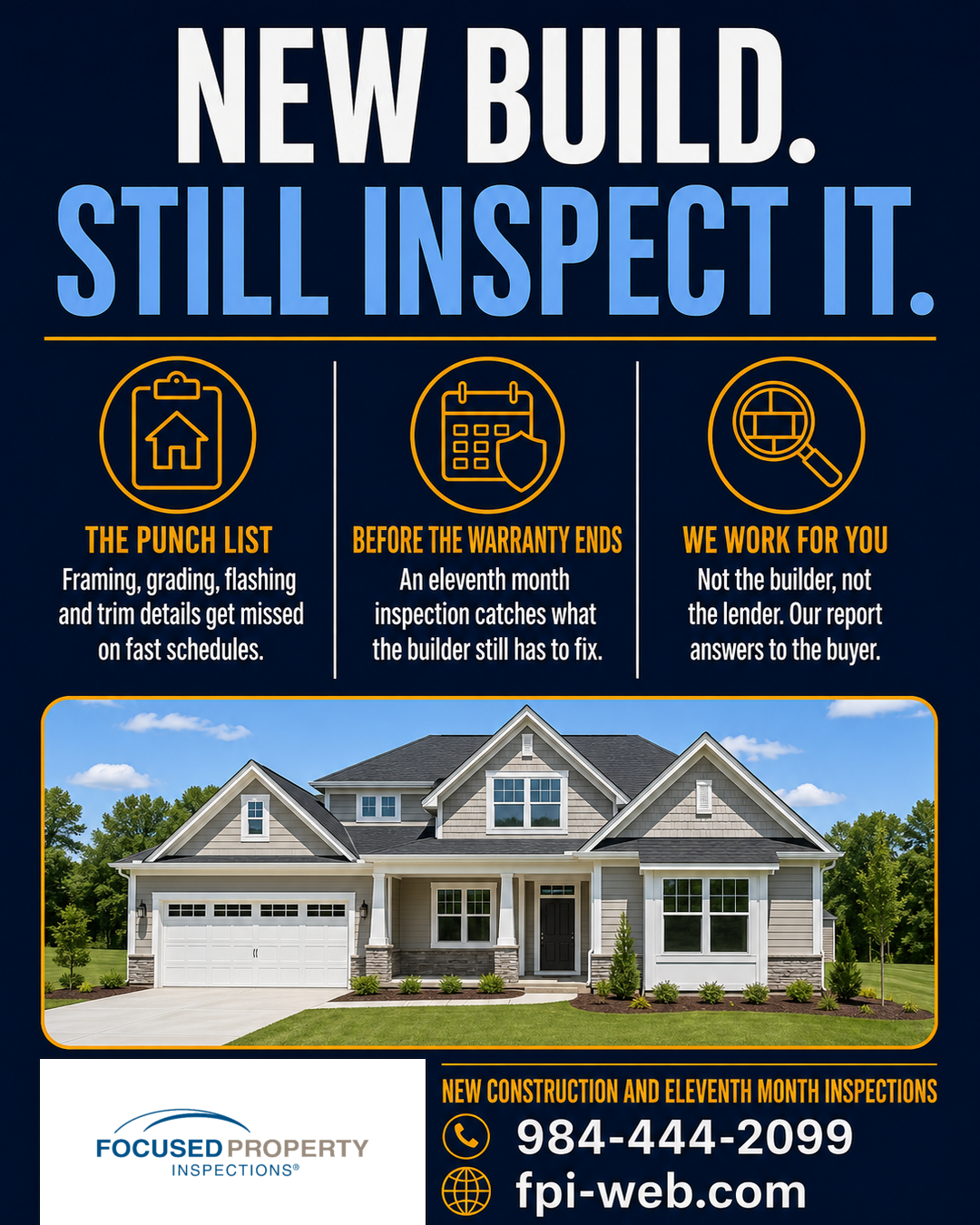
We see the gap between those two checks on almost every new-construction walkthrough we run. A house can clear its final municipal inspection and still hand a buyer a punch list a page long: a bath fan vented into the attic instead of outside, a furnace that was never balanced room to room, grading that slopes toward the foundation instead of away from it because the loam went down after the final grade was already signed off, trim nails backed out where the framing shrank over its first heating season. None of that fails a code inspection. All of it is exactly what a buyer’s own inspector is there to catch before the closing, not after.
Radon is the cleanest example of why “new” and “checked” are not the same word. The EPA is direct about it: every new home should be tested for radon after occupancy, whether or not radon-resistant features were built in, because levels vary house to house even on the same street and even in a home that is airtight and efficient by design. A builder can install the gas-permeable layer, the sealed sub-slab plastic, and the vent stack to the roof and still hand over a house that needs a fan added later if a test comes back at or above the EPA’s action level of 4 picocuries per liter. Nobody along the permit-to-closing chain is required to run that test for the buyer. We are, when a buyer or their agent asks us to.
New Hampshire does regulate who is allowed to do that kind of inspecting for hire, and it is worth knowing what that license actually requires, because it tells you what a real one is worth. Under RSA 310-A:190, a licensed home inspector in this state has completed at least 80 hours of board-approved instruction across the major systems of a house, passed the board’s exam, cleared a criminal background check, and demonstrated the “good professional character” the statute requires before the state will put a license in their hand. That is a real bar, and it exists precisely because New Hampshire decided the person a buyer hires to look at the most expensive purchase of their life should not be whoever answers the phone first.
None of this is a knock on the builders putting up the new inventory the Seacoast badly needs, or on the towns issuing the permits that make it possible. The pace New Hampshire Housing is describing is good news for a market that has been short on supply for years. It just means the buyer’s side of the transaction has to do its own job, on its own timeline, separate from the town’s. A permit tells you the house was allowed to be built. A certificate of occupancy tells you it was allowed to be lived in. Neither one tells you what the crawlspace looks like, what the attic insulation is actually doing, or what a radon test on that specific lot will read six weeks after you move in.
“People hear ‘new construction’ and assume that means finished and checked,” said Darryl Chandler, CMI, founder of Focused Property Inspections and an inspector across Maine and New Hampshire for thirty years. “It means built to a minimum standard on the day it was inspected by the town. Those are different things, and the difference is usually a few thousand dollars of punch-list work or a radon fan the builder never had a reason to think about.”
If you are closing on a new build anywhere from Portsmouth to Dover to Rochester this fall, put a private inspection and a radon test on the calendar before the closing date, not after. Focused Property Inspections covers New Hampshire alongside Maine, and our inspectors place and recover the radon sensor and report the reading directly. You can schedule both through our radon testing page or by calling (207) 839-6595. A brand-new house is still worth a second, independent look before it is yours.